


The Great Migration
The Great Migration is one of the most impressive natural phenomena in Africa. Every year, hundreds of thousands of wildebeest, accompanied by zebras and gazelles, move through the Serengeti ecosystem. Many people imagine a clearly planned sequence.
In reality, it is an ongoing cycle that is strongly influenced by rain, grass growth and natural dynamics. This article explains when and where the great migration is in the course of the year and helps to develop realistic expectations.
What is the Great Migration?
The Great Migration, also known as the Great Migration, describes the annual migration of over a million wildebeest and large populations of zebra and gazelle in East Africa.
It does not follow a fixed calendar, but the natural rain cycles. The goal of the hike is always the same: fresh grass and water.
At the center of this action is the Serengeti, whose vast plains form the basis for this extraordinary animal migration in Africa.
Why the Great Migration is not a single event
A common mistake is to view the Great Migration as a one-off highlight. In fact, it is a permanent movement within a huge ecosystem. The animals are on the move all year round, only their concentration in certain regions changes.
Rainfall allows grass to grow, dry spells force the herds to move on. This results in shifts that cannot be pinpointed to an exact date. If you want to understand the great migration, you should therefore see it as a cycle and not as a one-off spectacle.
Great Migration: When and where during the year?
January to March
In the south of the Serengeti and in the Ndutu region, the herds are often found in large numbers. This phase is characterized by calving, as the fresh grass offers optimal conditions.
April to May
With the onset of the longer rainy season, the animals slowly start moving towards the Central Serengeti. The herds become more dispersed as water and food are available in many places.
June to July
Migration shifts to the western and central areas. The first major river crossings may take place, depending on the water level of the rivers.
August to October
In the northern Serengeti, many herds reach the border regions. River crossings are frequently observed during this time, although irregularly and not daily.
November to Decembermber
With the short rains, the gradual migration back to more southerly regions begins. The herds move back south in a wide arc.
The following overview shows when and where the great migration typically occurs in the Serengeti. Deviations due to weather patterns are possible at any time.

The most important phases of the great migration
Calving
Between January and February, many wildebeest give birth to their calves in a short period of time. This natural event mainly takes place in the Ndutu region and attracts numerous predators.
Hike
After the calving season, the continuous migration begins. The herds move in loose formations through different regions of the Serengeti, always following the best food supply.
River crossings
River crossings, for example on the Mara River, are a particularly well-known but unpredictable element of the great migration. Whether and when they take place depends entirely on natural conditions.
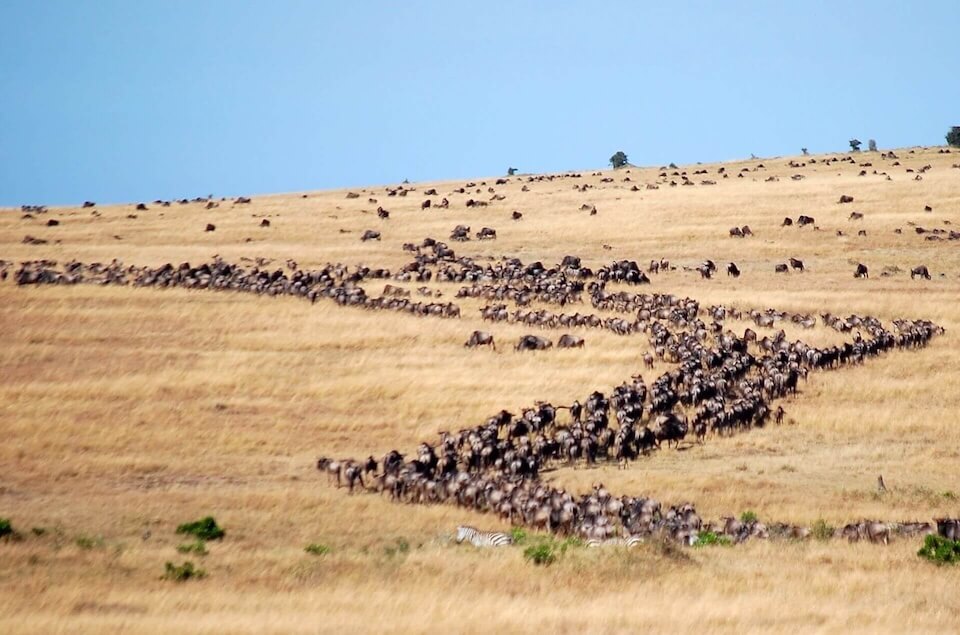
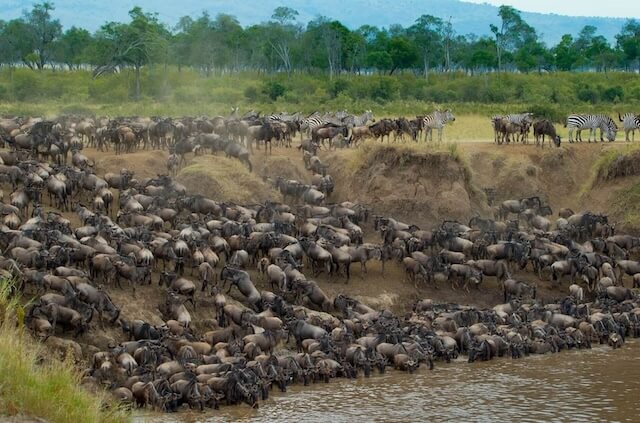
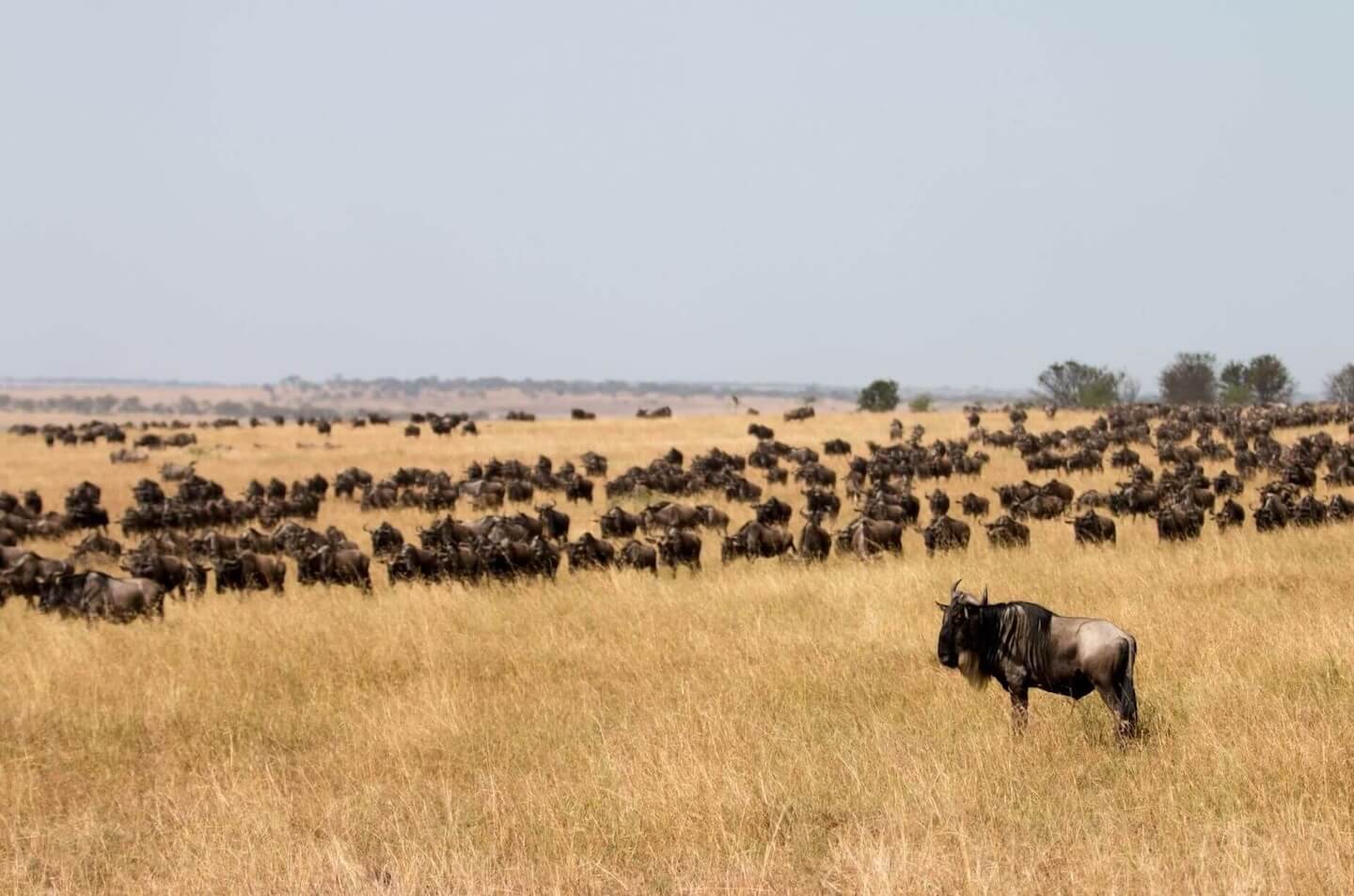
Great migration: Serengeti or Masai Mara?
The great migration not only moves within the Serengeti, but also occasionally crosses national borders. Some of the herds move to the Masai Mara in Kenya.
The difference lies less in the event itself than in the landscape. While the Serengeti is known for its vastness and openness, the Masai Mara appears more compact. Migration is part of the same ecological system in both regions and should not be seen as separate phenomena.
Common misconceptions about the Great Migration
Is it possible to plan the Great Migration precisely?
No. There are empirical values, but no guarantee for specific locations at fixed times.
Do you always see the herds in large numbers?
Not continuous. Phases with high density alternate with widespread distribution.
Is the Great Migration the same every year?
No. Rainfall and environmental factors result in slightly different patterns every year.
Conclusion: When and where you can experience the Great Migration
The Great Migration is not a fixed event, but a living, year-round process. Anyone who understands when and where the herds are typically found can realistically classify this natural phenomenon. It is crucial to understand that nature does not work according to a calendar, but according to its own rules.
You can find out more about the Great Migration Safari in Tanzania here: